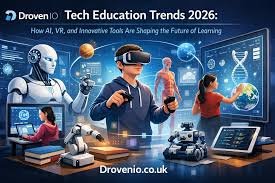
Technology has transformed nearly every part of modern life, and education is one of the biggest areas experiencing change. From online classrooms to artificial intelligence tools, students and teachers now have more resources than ever before. One rising topic in this space is droven-io-tech-education-trends, which highlights how innovation is reshaping the way people learn, teach, and grow professionally.
The concept of droven-io-tech-education-trends focuses on combining advanced technology with practical education systems. It reflects the shift toward smarter learning environments where students gain skills faster, teachers manage lessons efficiently, and institutions adapt to global demands. As the digital world expands, understanding droven-io-tech-education-trends becomes essential for anyone interested in the future of education.
The Rise of Digital Learning Platforms
One of the most important parts of droven-io-tech-education-trends is the growth of online learning platforms. Traditional classrooms are no longer the only option for education. Students can now access courses from anywhere in the world using laptops, tablets, or smartphones.
This flexibility has made education more inclusive. People who work full-time, live in remote areas, or need self-paced learning can now study without barriers. Droven-io-tech-education-trends shows that digital learning is not just a temporary solution—it is a long-term transformation.
Online platforms also offer recorded lectures, quizzes, discussion boards, and downloadable resources. These tools make learning interactive and efficient. As more institutions adopt these systems, droven-io-tech-education-trends continues to gain attention worldwide.
Artificial Intelligence in Education
Artificial intelligence is another key factor in droven-io-tech-education-trends. AI-powered tools can personalize learning experiences by analyzing a student’s strengths and weaknesses. Instead of giving every learner the same material, AI systems recommend lessons based on progress and performance.
For example, a student struggling with math may receive extra practice questions, while another excelling in science may move to advanced topics. This personalized approach improves learning outcomes and boosts confidence.
Teachers also benefit from AI. Automated grading systems, attendance tracking, and lesson planning tools save valuable time. With these advantages, droven-io-tech-education-trends demonstrates how AI supports both students and educators.
Virtual Reality and Immersive Learning
Virtual reality (VR) and augmented reality (AR) are changing classrooms in exciting ways. These tools are becoming a major topic within droven-io-tech-education-trends because they create immersive learning experiences.
Instead of only reading about ancient civilizations, students can virtually walk through historic cities. Medical students can practice surgeries in safe digital environments. Engineering learners can interact with 3D models of machines.
This hands-on approach increases engagement and memory retention. Many experts believe VR and AR will become standard tools in schools and universities. That is why droven-io-tech-education-trends often highlights immersive learning technologies.
Skills for the Future Workforce
Modern education is no longer focused only on textbooks and exams. Employers now seek digital skills, creativity, communication, and problem-solving abilities. Droven-io-tech-education-trends reflects this shift toward career-ready learning.
Students today need coding knowledge, data literacy, cybersecurity awareness, and adaptability. Schools are redesigning curriculums to include these subjects. At the same time, soft skills like teamwork and leadership remain important.
By blending technical knowledge with practical skills, droven-io-tech-education-trends helps learners prepare for future careers. This approach ensures students are ready for industries that continue to evolve rapidly.
Remote and Hybrid Education Models
The popularity of remote and hybrid education is another strong example of droven-io-tech-education-trends. Hybrid models combine in-person teaching with online tools, giving students more control over how they learn.
For instance, learners may attend some classes on campus while completing assignments online. This balance offers flexibility while maintaining face-to-face interaction. Many institutions now prefer hybrid systems because they reduce costs and increase accessibility.
As internet access improves globally, droven-io-tech-education-trends suggests hybrid learning will remain a major part of education systems.
Data-Driven Decision Making
Educational institutions now use data to improve teaching methods and student success rates. This is another important area of droven-io-tech-education-trends. Schools collect information on attendance, grades, engagement levels, and course completion rates.
By analyzing this data, educators can identify struggling students early and provide support before problems grow larger. Administrators can also see which programs are most effective and where resources should be invested.
With smarter decision-making powered by analytics, droven-io-tech-education-trends is helping schools become more efficient and student-focused.
Challenges in Tech Education
While the benefits are clear, droven-io-tech-education-trends also includes challenges that must be addressed. One issue is the digital divide. Not all students have access to reliable internet or modern devices. Without equal access, some learners may fall behind.
Another concern is data privacy. As schools use online systems, protecting student information becomes essential. Cybersecurity measures must improve to keep personal data safe.
Teacher training is another challenge. Educators need support to learn new technologies and integrate them effectively into lessons. Recognizing these issues is part of understanding droven-io-tech-education-trends fully.
Lifelong Learning and Upskilling
Education is no longer limited to childhood or university years. Adults now return to learning throughout their careers. This trend is central to droven-io-tech-education-trends because industries constantly change.
Workers often need new certifications, technical skills, or management training to stay competitive. Online courses and micro-credentials make this easier than ever. Professionals can learn without leaving their jobs.
The growth of lifelong learning proves that droven-io-tech-education-trends is not only for students—it benefits everyone seeking growth and career advancement.
The Future of Education
Looking ahead, droven-io-tech-education-trends will likely continue expanding. AI tutors, global classrooms, blockchain certificates, and personalized learning systems may soon become normal. Education will be more connected, flexible, and skill-oriented than ever before.
Students will have access to worldwide opportunities, while teachers will use smarter tools to guide learning journeys. Institutions that embrace innovation will stay competitive in a fast-changing world.
Conclusion
The world of learning is evolving quickly, and droven-io-tech-education-trends captures this transformation perfectly. From AI and VR to hybrid learning and workforce preparation, technology is making education more effective and accessible.
Although challenges like access and privacy remain, the future looks promising. As schools, businesses, and learners continue adapting, droven-io-tech-education-trends will remain a valuable guide to understanding what comes next in modern education.
Leave a Reply